

Islamic Revolutionary Guard Corps
Terminology
Organization
Guard Corps

History and structure
Thus, the Pasdaran, along with its political counterpart, Crusade for Reconstruction, brought a new order to Iran. In time, the Pasdaran would rival the police and the judiciary in terms of its functions.


Military structure
Cyber Security Command of the Islamic Revolutionary Guard Corps
Joint Staff
Basij

Lengkapi diri Anda, dapatkan pelatihan militer, dan latih teman-teman Anda. Berikan pelatihan militer kepada mereka yang tidak terlatih. Di negara Islam, setiap orang harus menjadi tentara dan menjalani pelatihan militer. … sebuah negara dengan 20 juta pemuda [harus memiliki] 20 juta penembak, dan 20 juta tentara”
Quds Force
Aerospace Force

Navy
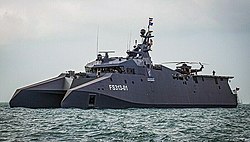
Ground forces
Nuclear forces
Intelligence organization
Auxilaries
The IRGC has recruited, funded, and trained two key militias to fight in Syria, Iraq, and Yemen as well as Iranian Balochistan which are led by IRGC commanders and even operate from Iran. These are:


Size

Senior commanders
- Major General
- Major General
- Brigadier General
- Brigadier General
- Brigadier General
- Commodore
- Brigadier General
- Brigadier General
- Brigadier General
- Brigadier General
Iran–Iraq War
Lebanon Civil War
2006 Lebanon War
2006 plane crash
Possible attacks on Quds Force
October 2009 Pishin bombing
Syria, 2011–2024
Iraq, 2014–present
2014 Israeli drone shoot down
Ukraine International Airlines Flight 752
Hostage Rescue inside Pakistan
Involvement in the Russo-Ukrainian war
April 2024 Iranian strikes against Israel
June 2025 Iran–Israel war
- Hossein Salami, commander in chief of the Islamic Revolutionary Guards Corps,
- Mohammad Bagheri, chief of staff of the armed forces and the second-highest commander after Ayatollah Khamenei.
- Gholamali Rashid, deputy commander in chief of the Armed Forces.
- Amir Ali Hajizadeh, head of the airspace unit of the Revolutionary Guards.
- Gholamreza Mehrabi, deputy intelligence chief of the Armed Forces.
- Mehdi Rabbani, deputy commander of operations for the Armed Forces.
- Davood Sheikhian, the commander of air defense.
- Khosro Hassani, the deputy intelligence chief of the aerospace unit.
- Mohammad Kazemi, the head of the intelligence
- Hassan Mohaqiq, the deputy to General Kazemi.
Influence
Political

Economic activity
- Sahel Consultant Engineering
- Sepasad Engineering Co. (excavation and tunnel construction)
- Gharargahe Sazandegi Ghaem
Environmental
Analysis
U.S. Department of the Treasury terrorist aid claims
Corporations in media
Similar organizations
Controversy
Terrorist designation and sanctions

Response to terrorist organization designation
See also
References
Notes
References
- ^
- ^
These efforts flow from Article 11 of the IRGC’s 1982 statute, which expressly requires the organisation to train and educate its members according to Islamic teachings and to promote the Khomeinist constitutional principle of velayat-e faqīh (Guardianship of the Jurist) in ideological, political, and military domains
Iran, already an Islamic Republic, leveraged the Shi’a Islamist Ideology to gain support and recruitment from within and beyond Iran, with a specific view towards defending against threats—real or perceived—to the Shi’a Muslim identity, and to further a revolutionary Shi’a Islamist ideology. Iran’s military, specifically the IRGC, is unique in the sense of not only using sectarian differences to effect its political will domestically, but also to further its ideology beyond its national borders, garnering support and traction from Shi’a political pockets across the region.
- ^
- ^
- ^
- ^
- ^
- ^
- ^
- Rothwell, James (4 January 2023).
- ^
- ^
- ^
- ^
- ^
- ^
- ^
- ^
- ^
- ^
- ^
- ^
- ^
{{: CS1 maint: deprecated archival service (- ^
- ^
- ^
- ^
- ^
- ^
- ^
- ^
The Revolutionary Guards are no longer simply a military institution. They are among the country’s most important economic actors, controlling an estimated ten percent of the economy, directly and through various subsidiaries.
- ^
- ^
- ^
- ^
- ^
- ^
iran revolutionary guard liquor.
- ^
- ^
- ^
- ^
Sources
- Alfoneh, Ali (Fall 2008).
Further reading
- Alemzadeh, Maryam (2021). “The attraction of direct action: the making of the Islamic Revolutionary Guards Corps in the Iranian Kurdish conflict”. British Journal of Middle Eastern Studies. 50 (3): 589–608.
- Azizi, Arash (November 2020). The Shadow Commander: Soleimani, the US, and Iran’s Global Ambitions. New York: Oneworld Publications.
- Forozan, Hesam. The Military in Post-Revolutionary Iran: The Evolution and Roles of the Revolutionary Guards c. 2017
- Johny, Shelly (2007).
- Ostovar, Afshon. Vanguard of the Imam – religion, politics, and Iran’s Revolutionary Guards (Oxford University Press, 2016)
- Posch, Walter (2024).
- Safshekan, Roozbeh; Sabet, Farzan, “The Ayatollah’s Praetorians: The Islamic Revolutionary Guard Corps and the 2009 Election Crisis”, The
- Silinsky, Mark D. Empire of Terror: Iran’s Islamic Revolutionary Guard Corps (Potomac Books, 2021)
- Wise, Harold Lee (2007).
